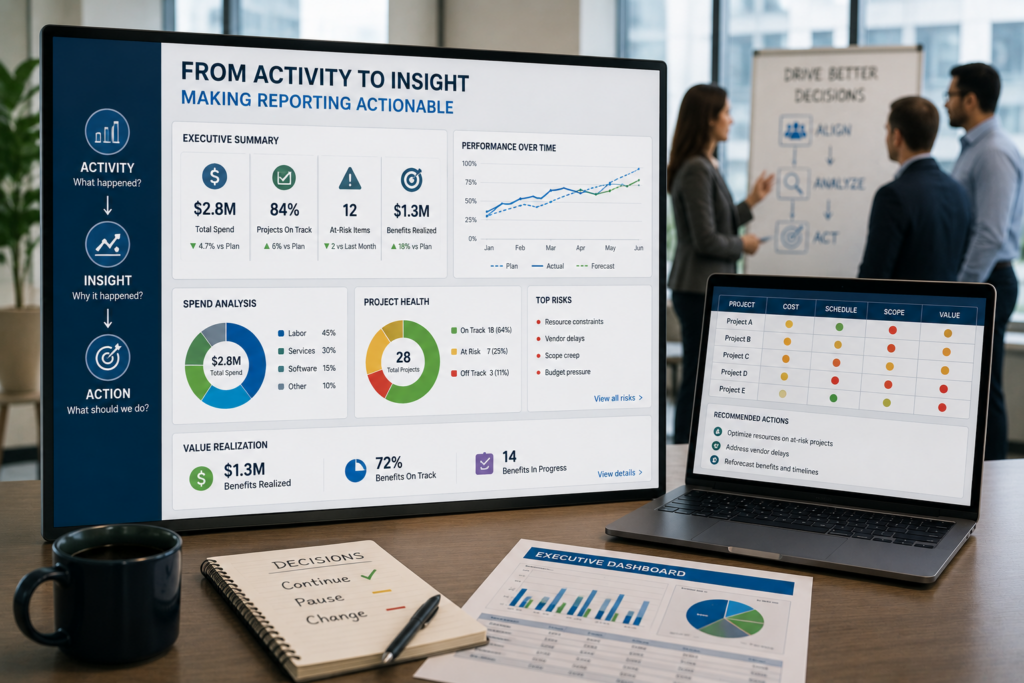
Reporting is only valuable when it drives decisions. Many organizations are effective at approving work but less disciplined about deciding what should continue, pause, or change. Without that second step, reporting becomes a record of activity rather than a tool for managing value.
One of the biggest barriers is fragmented data. Financials, sourcing, project delivery, and operational metrics often live in separate systems with different structures and timelines. A common example is project value reporting, where delivery status, actual spend, contract terms, and expected benefits must be combined to understand true performance. When these elements are disconnected, decision-making slows or becomes inconsistent.
Time alignment adds another layer of complexity. Operational data is often current, while financial data lags due to billing cycles and accrual processes. Bringing together invoices, accruals, time tracking, and delivery progress into a single, forward-looking view is critical. Without it, teams are left interpreting partial snapshots rather than making informed projections.
Historical data offers a practical way forward. Instead of relying on fixed timelines or optimistic assumptions, organizations can use past performance to improve forecasting. Predictive modeling, even at a basic level, can help set more realistic delivery expectations and identify where plans are likely to slip.
Another common issue is over-reliance on output metrics. Dashboards often show how much work has been completed, but not whether that work is delivering business value. Shifting reporting to focus on outcomes, such as cost savings realized, service improvements achieved, or risks mitigated, provides a clearer picture of impact.
End-to-end visibility is equally important. Performance can appear strong within individual functions while the overall result falls short due to misaligned goals or poor handoffs. Reporting should connect the full lifecycle, not just isolated segments, to reveal where breakdowns occur.
Finally, clear ownership of data is essential. When reporting is assembled ad hoc across teams, accuracy and consistency suffer. Assigning ownership of key domains, such as billing, inventory, contracts, and lifecycle management, creates accountability and improves reliability.
When reporting evolves from tracking activity to guiding decisions, it becomes a core capability for managing technology investments and delivering measurable business value.
Ready to take the next step? Explore how the AOTMP® TEM Performance & Value Alignment Program helps organizations benchmark, optimize, and elevate their technology management outcomes. Learn more or enquire now →