AI platform billing is evolving quickly, and many technology teams are unprepared for how different it is from traditional SaaS or telecom cost models. Understanding a few core concepts can prevent surprises and improve cost control.
Understanding the Billing Model
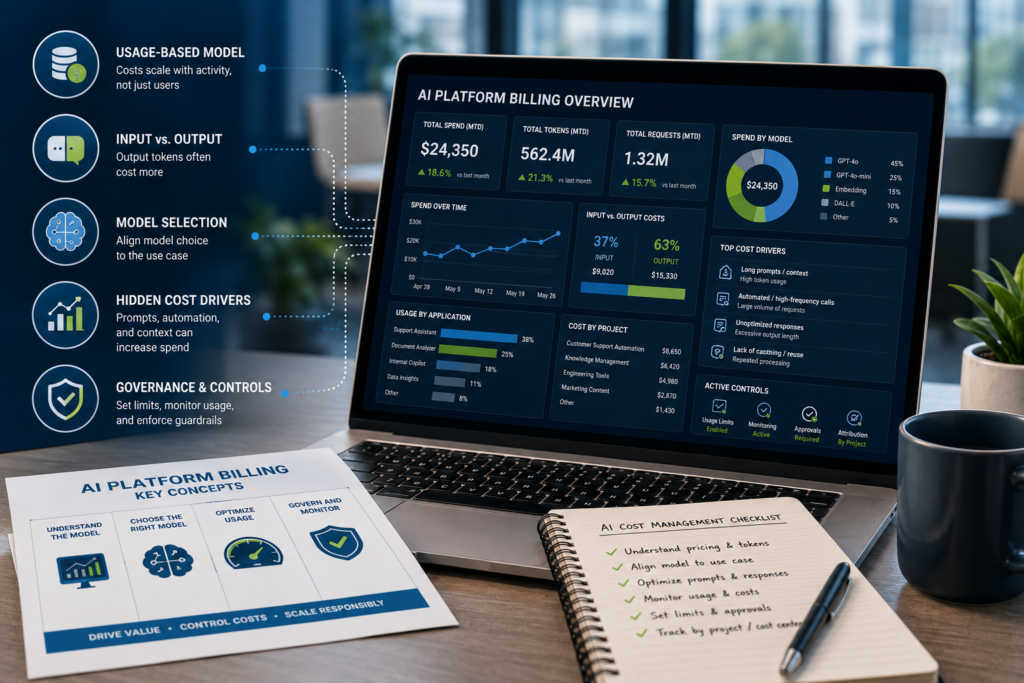
Most AI platforms charge based on usage rather than fixed subscriptions. The primary unit is often a token (for language models), which represents a chunk of input or output text. Costs can vary by model type, request size, and response length. Other services, such as image generation, embeddings, or fine-tuning, introduce separate pricing dimensions.
This means costs scale with activity, not just user count. A single automated workflow or chatbot can generate significant usage if not properly designed.
Input vs. Output Costs
AI billing typically distinguishes between input (what you send to the model) and output (what the model generates). In many cases, output tokens are more expensive. Poor prompt design, excessive context, or unnecessarily long responses can drive up both.
For example, a support automation tool that sends full ticket histories with every request may multiply costs without improving outcomes.
Model Selection Matters
Different models have different price-performance trade-offs. Higher-end models deliver better reasoning but at a higher cost per token. Lower-cost models may be sufficient for summarization, classification, or basic tasks.
A practical approach is to align model choice to use case rather than defaulting to the most advanced option.
Hidden Cost Drivers
Several factors can inflate AI spend if left unmanaged:
- Overly long prompts or repeated context.
- High-frequency automated calls (e.g., background agents).
- Lack of caching or reuse of previous results.
- Poorly defined stopping conditions in workflows.
These issues are often invisible until bills arrive.
Governance and Controls
AI billing requires active management. Key practices include:
- Setting usage limits or quotas for teams or applications.
- Monitoring usage patterns and anomalies.
- Implementing approval workflows for new AI use cases.
- Tagging or attributing usage to specific projects or cost centers.
Without this, costs can grow unpredictably.
FinOps for AI
Traditional cost management approaches need to adapt. AI introduces real-time, consumption-based spending that spans the infrastructure, platform, and application layers. Teams should treat AI usage like cloud spend –continuously optimized, monitored, and tied to business value.
The organizations that manage AI costs effectively are not those that restrict usage, but those that design, monitor, and refine how AI is used.
Ready to take the next step? Explore how the AOTMP® TEM Performance & Value Alignment Program helps organizations benchmark, optimize, and elevate their technology management outcomes. Learn more or enquire now →