
Vendor management has always required a balance between efficiency and flexibility. As organizations grow, a key question arises: Should you consolidate with a single strategic provider or maintain a diverse ecosystem of specialized vendors?
Where Consolidation Delivers Value
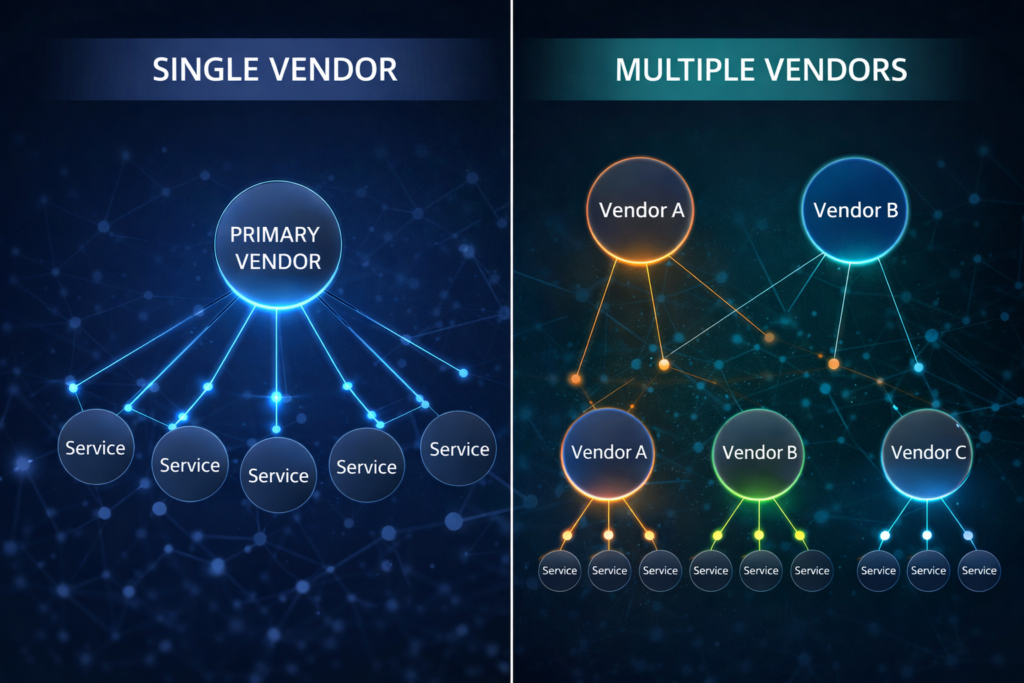
Vendor consolidation simplifies governance, particularly in regulated industries. Managing fewer contracts means less time spent on due diligence, onboarding, and compliance audits. It also reduces the number of SOC documentation cycles and security reviews. However, the trade-off may be a less direct connection to the underlying vendors providing services.
For companies where vendor onboarding takes months, consolidation often proves beneficial. The operational burden of managing multiple partners can outweigh the incremental advantages of lower prices or specialized features. Many organizations choose to expand their service portfolios through existing trusted partners, accepting less direct control over carriers in exchange for simplified oversight.
When Best-of-Breed Still Matters
Some enterprises resist the “one-throat-to-choke” approach to maintain direct control over performance-critical relationships. Using multiple vendors can enhance agility, responsiveness, and cost competition, even if it adds complexity to contract management and integration processes.
However, fragmentation comes at a cost. Each additional provider increases the number of contracts, integrations, and governance activities, which consumes valuable time from IT, procurement, and business unit leaders.
Finding the Balanced Path
Relying too heavily on a single strategic vendor can reduce competitive tension and obscure service quality issues, especially when the primary vendor subcontracts underlying services. Performance can fluctuate, and expecting consistent excellence from a single provider is risky.
The most resilient strategy combines both models. Consolidate where compliance and operational overhead are highest while preserving selective best-of-breed relationships that enhance cost efficiency, control, or performance. Many organizations adopt a “champion-challenger” framework, keeping a primary provider while consistently testing alternatives. This approach maintains accountability and ensures readiness in the event of performance dips.
Ultimately, the best vendor strategy empowers you to control your own destiny: simplify where it matters most and diversify where it provides measurable business value.
Interested in learning how your peers tackle this topic? Become a Professional Member today (it’s FREE to join!)
Interested in learning more about this topic? Silver Membership provides hundreds of essential guides, templates, eBooks, and other resources!
Interested in learning more about this topic? Discover courses and certifications with a Gold Membership to help you master technology management best practices.