As AI agents become more powerful, the temptation to fully automate end-to-end workflows grows. In technology expense management (TEM) and mobility operations, this might mean allowing agents to suspend lines, place orders, or submit disputes without human review. While appealing on efficiency grounds, this approach can introduce significant business risk when agents misinterpret rules, misread data, or act on outdated context.
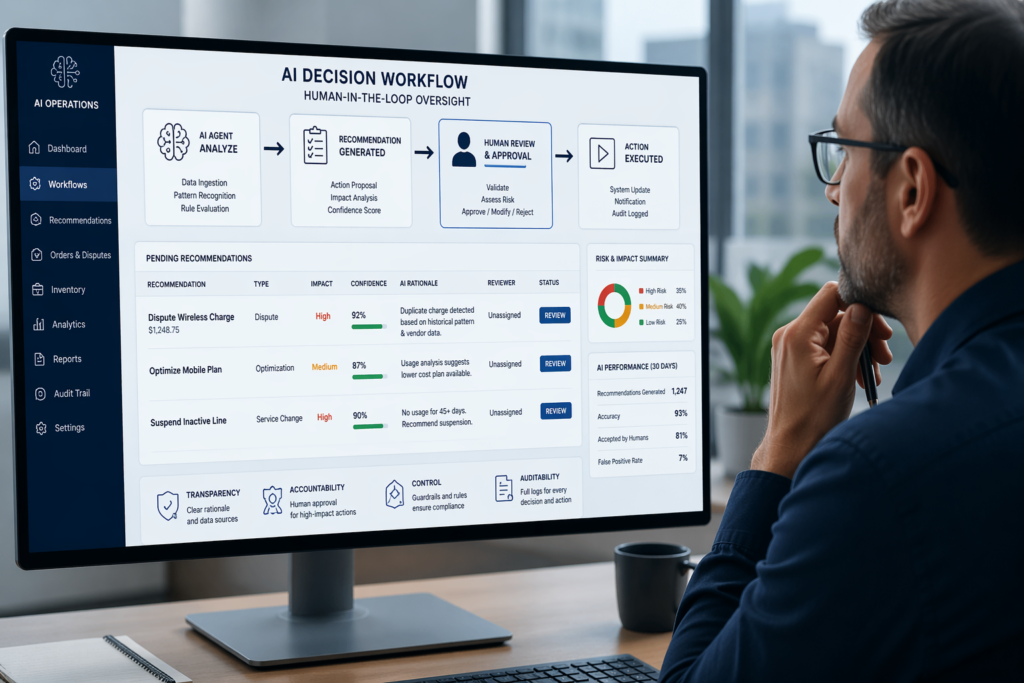
A human-in-the-loop model balances automation with oversight. For high-risk actions (e.g., anything that changes a customer’s bill, impacts service availability, or commits the organization to a contract), AI should propose, not execute. Agents can draft dispute language, recommend optimization actions, or suggest order changes, but a trained analyst should review and approve before submission. This preserves speed while maintaining accountability.
Effective human-in-the-loop design starts with clear workflow segmentation. Identify which tasks are low-risk and repetitive, such as data normalization or summarizing usage patterns, and which tasks carry higher financial, regulatory, or customer-experience stakes. Then assign appropriate guardrails: fully automated for low-risk activities, human review for medium-risk activities, and human-led with AI assistance for high-risk activities.
Training is critical on both sides. AI agents must be tested extensively with real data to validate their logic, citations, and edge-case behavior. Humans must be trained to spot subtle errors, question implausible recommendations, and avoid over-trusting outputs simply because they appear polished. Establishing feedback loops, whereby analysts flag issues and development teams iteratively improve configurations, helps agents become safer and more effective over time.
Finally, document decision rights and escalation paths. When something goes wrong, leaders must be able to trace which actions were automated, which were human-approved, and what data was used. Clear logs and audit trails support compliance, continuous improvement, and transparent communication with stakeholders. In complex domains like TEM and mobility, human-in-the-loop is not a limitation on AI; it is the key to deploying AI responsibly at scale.
Ready to turn AI best practices into measurable results? Explore how the AOTMP® TEM Performance & Value Alignment Program helps organizations benchmark, optimize, and elevate their technology management outcomes. Learn more or enquire now →
Interested in learning how your peers tackle this topic? Become a Professional Member today (it’s FREE to join!)
Interested in learning more about this topic? Silver Membership provides hundreds of essential guides, templates, eBooks, and other resources!
Interested in learning more about this topic? Discover courses and certifications with a Gold Membership to help you master technology management best practices.